Table of Contents:
What's a Radial Tire?
Agota Szabo - November 4, 2018
Table of Contents:
Since we’ve already talked about bias ply tires, we should probably talk about radial tires. Even if you’ve never heard of radial tires, you’ve almost definitely used them. You see, the radial construction is how most modern tires are made, so it doesn’t hurt to know a little more about it.
Plies (a brief recap)
Although we went over plies when we talked about bias construction, I’m still going to give you a little bit of a recap. Plies are sheets made from a variety of durable textile materials (thin steel cables, nylon, kevlar, etc.) which are inlaid with rubber to form a thin sheet. These sheets are then layered to form the internal structure of the tire, where they give it its strength and its shape.
So What is Radial Construction?
Unlike with bias tires, where the plies are laid in a diagonal, radial tire plies go straight across from one bead to the other. The plies are usually laid out at 90 degrees from the center line, so when I say straight across I mean straight across. This allows the sidewall and the tread area of the tire to function separately, while also increasing the structural integrity.
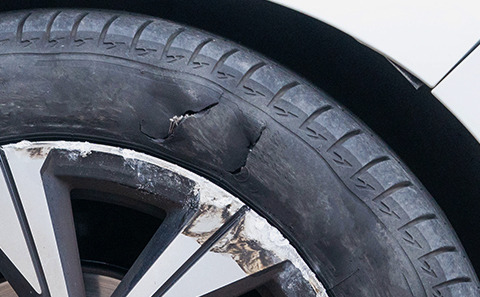
So what difference does this make? Well, as I already said, the sidewall and the crown are independent of each other, which makes for a smoother ride. But, because the layers don’t overlap, they’re a little more susceptible to damage.Let’s talk about the pros and cons:
Pros
- Longer tread life and greater stability
- Better rolling resistance
- Better heat distribution (so less chance of overheating)
- Greater flexibility and shock absorption for a smoother ride
Cons
- Not good for heavy equipment or large trailers
- Not as robust, so more susceptible damage
- More expensive.
Belts
Unlike bias tires, belts are pretty standard in radial construction. They add extra reinforcement to the tread area while allowing the sidewall to remain flexible enough to absorb bumps. This way, the tire’s footprint is stable and supported, but you get a smooth ride.
The belts can be made out of a variety of materials, but in radial tires they’re commonly steel. The belts are laid out on top of the plies at angles, crisscrossing to provide extra structural support. Since the belts are right beneath the tread layer, they smooth out the ride and keep the footprint from deforming. This not only makes them stable, but it also provides more traction as the footprint is generally wider and more stable than other constructions. On top of that, the extra support and the fact that they help separate the crown from the sidewalls means they last longer. It’s no wonder they took over the market!
Related Posts