Table of Contents:
How To Interpret the UTQG or Uniform Tire Quality Grade
Agota Szabo - October 15, 2018
Table of Contents:
Most of the passenger tires sold i n the US will have what’s called a UTQG, otherwise known as a Uniform Tire Quality Grade. This tire grading system is designed to give you an idea about a tire’s performance and durability. Not all tires have them, though. Tires for a 12” rim and smaller, winter tires, temporary spares, etc. won’t have this grading system. But most of your regular, everyday, passenger type tires should have this rating.
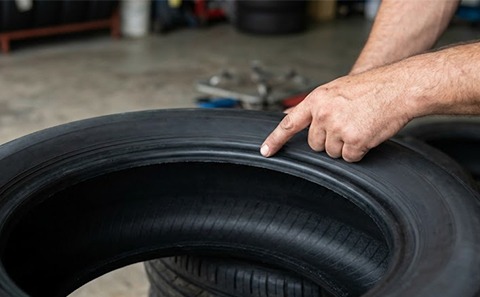
So what is a UTQG? Well, if you look at the picture above, you’ll see an example of it. It’s a code consisting of letters and numbers found on the sidewall of your tires. The letters and numbers are labeled under a specific category so that this code can give you a sense, at least broadly, of how these tires stack up in the industry.
However, it would help if you understood what those codes mean. So we’re here to break it down for you.
Who Assigns the UTQG?
First of all, who’s in charge here? Who decides what grade these tires get? Well, although the NHTSA (National Highway Traffic Safety Administration) requires UTQG ratings, they don’t actually do the rating. Instead, they leave it up to the manufacturers, which makes it a little bit of a flawed system (which is why we say it will give you a broad sense of how the tires stack up). That being said, they do hire independent companies to do the testing for the grades and the NHTSA can inspect the data and institute fines for inconsistencies, so it’s not that flawed.
On top of that, the rating system hasn’t been updated since the 1970s. Tire technology, meanwhile, has drastically improved since then, so the base of the scale is a little bit outdated.
While it shouldn’t be taken as gospel, the UTQG is still a good way to get an idea of where a tire stands. So, until they roll out a more updated system, it’s safe to remember that it’s a general idea.
The Ratings
- Treadwear
How long a tire will last is usually the first thing on your mind when buying a tire. Fortunately, there’s a rating to help you determine this. Unfortunately it’s the most obscure of the ratings in the UTQG.
It works like this: Manufacturers test their tires on a government specified test track. The tire is then assigned a number based on how it performs in comparison to the NHTSA’s reference tire.
This number rating is 3 digits, starting at 100 to represent the reference tire. In theory, a tire with a rating of 200 is predicted to last twice as long as the reference tire, and 300 three times as long. But if you want to know what that means in terms of mileage, you’re out of luck. There’s no mileage determination.
Also, although they’re tested on a government specified track and measured against a government established control, the NHTSA doesn’t actually do any of the testing or grading. That’s all the manufacturer. On top of that, because of the advancements in tire technology, modern tires tend to have really high grades. We’re talking grades in the 600, 700 or even 800s.
With that in mind, here’s what’s important: The higher the number grade, the longer a tire will last, at least according to the manufacturer.
Surprisingly, though, the tires with the lower ratings are not what you might expect. Instead of being the cheapest, budget-brand tires, it’s actually the more expensive high and ultra-high performance tires that get the lowest grades. These wide, low-profile tires are designed for performance over longevity, and they typically don’t even carry treadwear warranties when new. So maybe that budget-brand isn’t so bad after all.
- Traction
This rating is pretty straight forward (and specific). It measures the tire’s ability to generate traction while stopping in a straight line on a wet road. Just that. Not cornering, not on dry roads, not down a hill, just a straight line on a wet road. (I told you it was specific).
The ratings go from AA, A, B and C, with AA being the highest and C being the lowest. Only the best of the best are getting that AA, though, like the high- and ultra-high performance tires. Most passenger tires you see will have an A rating. This is really what you want, even if you’re just driving to the grocery store once a week. However, for that kind of light or infrequent driving, a B is also acceptable. If it’s a C rated tire, just back away slowly and get something else.
- Temperature
Tires get hot when you use them. Some tires get hotter than others (we’re looking at you, high performance tires). It’s just science: friction generates heat. But the temperature grade isn’t here to tell you how hot the tire gets. Instead, it measures how well it resists being damaged from that heat. Because heat damage can cause tire components to fail, break apart, or just lose pressure and structural integrity, this is an important thing to grade. C, the lowest grade, represents a tire that meets minimal government standards. B exceeds those standards. A is the highest temperature grade.
Just like the Treadwear rating, this grade goes with A, B and C, with C (again the lowest) representing meeting the minimal government standards. B exceeds the government standards and A is the highest grade. So, if your tires are regularly stressed, either from carrying heavy loads or high speed maneuvering, you’ll definitely want to look for those A tires.
How To Use UTQG
Now that you understand the UTQG, you can better judge those new tires, but remember: it’s just a guide. Don’t rely on the UTQG alone, because as we said in the beginning, it’s best for getting a general idea, not a sure thing.
So if you want to know how long a tire lasts, don’t just look at the UTQG, look at the mileage warranty, read the reviews! Because while the UTQG and warranty measurement systems may not be exact, when you look at them together they’ll definitely let you know which tires will last longer.
If you want to know how a tire performs in something other than a straight wet road, check the reviews! Other owners will tell you if a tire’s great in rain but terrible at corners, or if the snow traction is not up to par.
Reviews will also tell you things the ratings can’t. For example, a tire can meet the requirements for a higher temperature rating, but still have problems with temperature related issues. So if you see multiple reviews complaining about ply separation, it’s safe to assume that’s a frequent problem with that tire, despite the grade.
Basically, you should use your resources when buying tires, and the UTQG is just that: a resource.
Related Posts

What Is a Tire Iron: Must-Know Facts Before Your Next Flat Tire
Tina Alijevic - June 10, 2026